

ranjeet.sharmaimarcgroup
Member
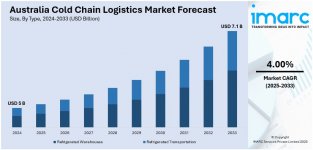
Market Overview
The Australia Cold Chain Logistics Market was valued at USD 5 Billion in 2025 and is projected to reach USD 7.1 Billion by 2034. This growth is supported by investments in refrigerated transportation and storage facilities, alongside advancements in AI-enabled robotics for improved inventory management. The forecast period spans from 2026 to 2034, with a compound annual growth rate (CAGR) of 3.80%.
For more information read Australia Cold Chain Logistics Market
https://www.imarcgroup.com/australia-cold-chain-logistics-market
How AI is Reshaping the Future of Australia cold chain logistics market
- AI-enabled robots and systems streamline inventory management, enhancing accuracy and reducing operational costs.
- AI algorithms analyze real-time and historical data to predict risks and enable swift corrective actions, minimizing product spoilage.
- Government initiatives, including the Albanese Government’s USD 1 billion investment plan, aim to develop national AI capabilities, improving operational efficiency.
- AI optimizes route planning for refrigerated transport, reducing fuel usage and delivery times.
- Autonomous vehicles and drones equipped with AI and temperature control systems enhance the efficiency and precision of last-mile deliveries.
- Implementation of AI in cold logistics ensures compliance with stringent safety standards, benefiting pharmaceuticals and perishable goods sectors.
Australia Cold Chain Logistics Market Growth Factors
The rising demand for frozen food products in Australia is a significant market driver. Consumers increasingly prefer frozen or refrigerated food items, boosting the need for temperature-controlled transportation and storage. Perishable goods like fruits, vegetables, dairy, meat, seafood, and bakery products require efficient cold chain systems to maintain freshness. Additionally, the growing consumer preference for organic products, fresh dairy, and ready-to-eat meals pressures logistics providers to adapt their cold storage and refrigerated transport networks. Companies invest heavily in refrigerated warehouses and temperature-controlled vehicles to preserve product integrity and comply with evolving quality and safety standards.
Increasing investments in automation technologies are transforming the Australia cold chain logistics market. The adoption of robotics, Internet of Things (IoT) sensors, and automated cold storage facilities with real-time condition monitoring is enhancing operational efficiency. Automated systems facilitate faster sorting, storing, and retrieval of temperature-sensitive goods, reducing human error and increasing throughput. The use of autonomous vehicles and drones equipped with temperature-control systems optimizes delivery schedules and minimizes manual intervention. These advancements collectively improve last-mile delivery efficiency, product safety, and overall cold chain reliability.
Pharmaceutical product demand growth is another important factor propelling market development. Vaccines, biologics, and specialty drugs require stringent temperature control throughout the supply chain for quality assurance. This has led to increased investment in refrigerated transportation and storage facilities equipped with real-time monitoring to avoid temperature deviations. Personalized medicine like cell and gene therapies also demand precise temperature management. Pharmaceutical companies in Australia are collaborating with cold chain logistics providers to comply with regulatory standards and meet export needs. The establishment of new manufacturing facilities, like Moderna’s mRNA vaccine center producing 100 million doses annually, further drives demand for effective cold chain logistics.
Australia Cold Chain Logistics Market Segmentation
Analysis by Type:
- Refrigerated Warehouses
- Refrigerated Transportation
- Railways
- Airways
- Roadways
- Waterways
- Fruits and Vegetables
- Bakery and Confectionary
- Dairy and Frozen Desserts
- Meat, Fish, and Sea Food
- Drugs and Pharmaceuticals
- Others
- Australia Capital Territory & New South Wales
- Victoria & Tasmania
- Queensland
- Northern Territory & Southern Australia
- Western Australia
- Hawk Logistics
- Farragher Logistics
- DHL Supply Chain (DHL)
- Merck
- Moderna
- December 2024: DHL Supply Chain announced a USD 46 Million investment to develop the largest automated life sciences warehouse systems in Australia and New Zealand, focusing on cold chain, security, and packaging needs.
- September 2024: Merck introduced greener cold chain shipment solutions in Australia, including switching to wool-pack insulation to replace 3.6 tons of non-recyclable expanded polystyrene annually, promoting sustainability.
- December 2024: Hawk Logistics expanded by acquiring Farragher Logistics, enhancing refrigerated transport services across Melbourne, Sydney, Brisbane, and Griffith to deliver reliable nationwide cold chain logistics.
https://www.imarcgroup.com/request?type=report&id=21995&flag=F
About Us
IMARC Group is a global management consulting firm that helps the world’s most ambitious changemakers to create a lasting impact. The company provide a comprehensive suite of market entry and expansion services. IMARC offerings include thorough market assessment, feasibility studies, company incorporation assistance, factory setup support, regulatory approvals and licensing navigation, branding, marketing and sales strategies, competitive landscape and benchmarking analyses, pricing and cost research, and procurement research.
Contact Us
IMARC Group,
134 N 4th St. Brooklyn, NY 11249, USA,
Email: sales@imarcgroup.com,
Tel No: (D) +91 120 433 0800,
United States: +1-201971-6302